.

The Free State
"Man, in a word, has no nature. What he has is - history."

Wednesday, June 17, 2009

Reflections on the Revolution in Iran


It was not so long ago that that Iran was made a member of the 'Axis of Evil' by George W. Bush. It was a crude, almost childish example of speech writing, awkwardly meshing a similarly cartoonish phrase Ronald Reagan used to describe the Soviet Union with a Hitlerite term that evokes the most terrible force, the darkest years the world has ever seen.

It did not square all that well with the actual members of the new 'Axis'. The governments of Iraq, Iran and North Korea had indeed varying degrees of 'evil' but it did seem profoundly misleading to compare their tin-pot dictatorships with Nazi Germany and the U.S.S.R. - two vast empires that had literally had the potential to destroy the United States and, perhaps, dominate the world. Never mind that the members of this supposed 'Axis' did not have particularly close relations and two of them - Iraq and Iran - had been at each others' throats for decades. Nonetheless, the totalitarian imagery was evocative, and served the administration's purpose of instilling a lurid and demonic, albeit somewhat blurry, image of the enemy into public opinion as the necessary prelude to all war and confrontation.

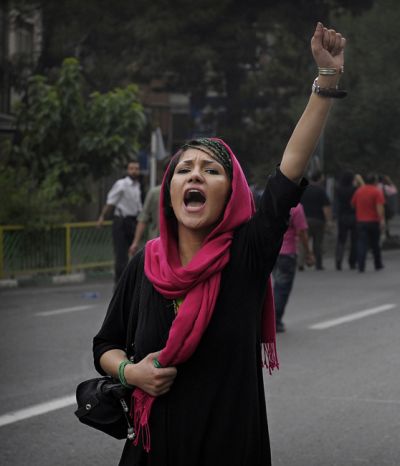
I can't help but be struck by the colossal number of spectacular images and video coming out of Iran right now (some here, TPM has lots) and how it will affect the country's image abroad. I think of the extent to which they both confirm and contradict preconceptions. Yes, there are big, intimidating rallies with foreign chants and banners with alien script. Yes, there are upturned cars and buses burn. Indeed, supporters of Mahmoud Ahmadinejad show off disturbing anti-American imagery and slogans. But much more striking is how normal the people of Iran must seem to those expecting a more terrorist-totalitarian-'Islamofascist' vibe. These people do not look like the submissive, deprived citizens of the Soviet Union or oppressively robotic North Koreans on parade. Nor do they for the most part look like the ghostly burqa-clad women that float around Kabul or the scraggly old crackpots in turbans that appear in Al Qaeda's periodic videos.

Instead, we witness a society that seems much like our own and yet enticingly exotic. Red-White-and-Green take the place of our own colors at the rallies. The ubiquitous green of everything - banners, shirts, faces, glasses - evoke not a frightening fundamentalism, but happy memories of Kiev. We see 40something males sporting their polos and paunches, marching in orderly fashion. There are long-haired young men in T-shirts and jeans that look like they were grabbed off some London campus. Pretty girls walk in their summer clothes - their modesty assured by a light scarf covering half their hair - sometimes with braids, sunglasses, make-up or even tank-tops.

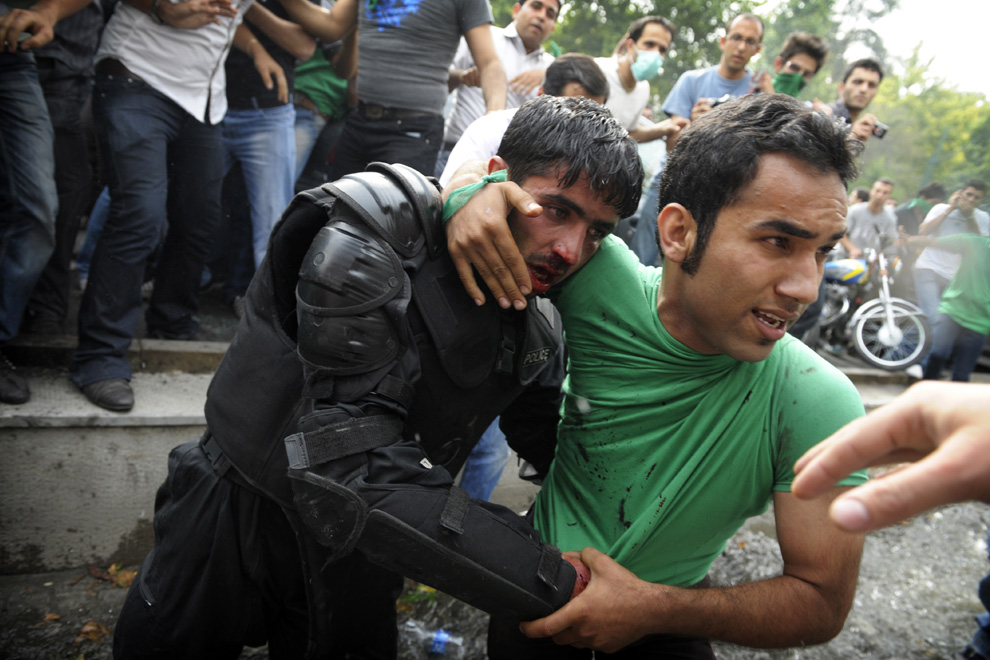
And we see them all gallantly face off with troopers wielding batons and wearing black body armor.

Instead of 1979, this feels like 1989. It is as though watching East Germans rallying against Communism as we hold our breath to see if the Russian tanks are rolled out. We look with apprehension for a repeat of Tiananmen. But would that be possible in the age of Facebook, cameraphones and YouTube? These tools, so frivolous in their normal usage, would ensure that every household knows the face of violence and tyranny. These events hold the potential to stir change in both the United States and Iran. That when gazing at the other, there would not be the ugly, distorted reflections of the "Great Satan" and the "Axis of Evil", but two nations might see each other for the first time.

Labels: , ,

Saturday, June 13, 2009

Depressing Poll

"Do most Islamic nations want to have a positive and peaceful relationship with the United States?"

In my insomnia, I have decided to write on a piece of news that has been bugging me for a while. According to a Rasmussen poll, a whopping 32% of Americans believe the answer to the above question is 'yes'. I don't know how Americans understood the question, but I find it disturbing no matter which way they interpreted it.


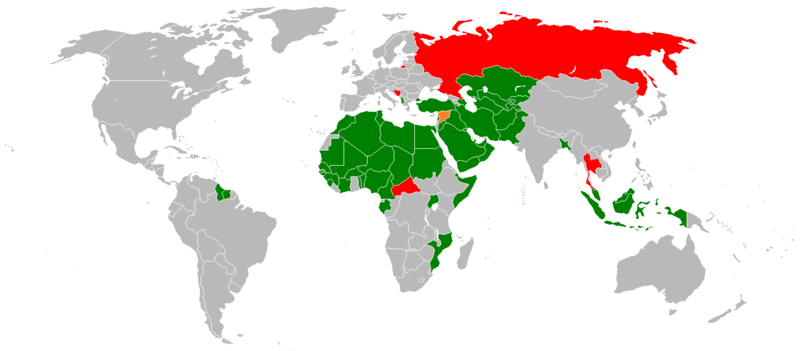
OIC participants

Did they interpret 'nations' to mean governments of Muslim-majority countries? Do they have any idea that the vast majority of these governments are either American allies or have normal relations with the United States? Of the 57 members of the Organization of the Islamic Conference, pretty much only Syria and Iran could be construed to be outright 'enemies'.


Kenyans

Did they forget that Muslim nations form a vast and diverse group, of which Middle Easterners form a surprisingly small minority? That the biggest Muslim country is Indonesia? Or that there are more Muslims in Africa or South Asia than the Middle East? Around two thirds of Americans apparently believe that the Muslim World - from the Senegalese peasants outside Dakar, to the Malay businessmen in Kuala Lumpur and from the godless post-Communist bureaucrats in Almaty to the jubilant Kenyans celebrating 'Obama Day' in Mombasa - on the whole wants conflict with the United States.

And is it not still terribly unreasonable, if we assume most respondents were ignorant that there are indeed Muslim countries outside of 'Arabia', to believe most ordinary men on the street in most Middle Eastern countries want bad relations with the United States in principle? Do they expect Americans in Egypt or Syria to be spat at in the street? I think it is better to be predisposed to the notion that ordinary people - to the extent they think about the United States - are more offended by specific U.S. policies than America itself until proven otherwise. That would seem to me understandable enough given that - for better and for worse - the pronounced and overwhelming American power and influence in the region is used with systematic disregard for the sentiments of its inhabitants.

Or is it that Americans have become prejudiced towards an entire religion because they have been saturated with images of violence, extremism and anti-Americanism from a handful of countries and terrorist movements? For all the talk of Iran and Hezbollah, all the lurid images of terror attacks and hysterical demonstrations, you will find almost nothing on the 1.5 billion Muslims strewn across every continent - Imams and agnostics, Sub-Saharan Africans and southeast Europeans, illiterate peasants and urbane intellectuals, burqa-clad women and make-up ladden girls in headscarves - characterized more by their differences than anything else. You almost never get a sense that they are people as one finds people in all corners of the globe, with their own painful struggles and petty worries, with their occasional exciting adventures and banal daily lives, with all their qualities and all their flaws. The effort to educate the American people on this issue, it seems to me, has been mismanaged with criminal negligence. We would do better to read more Fred Halliday and Alaa Al-Aswani.

Labels: ,

Tuesday, May 12, 2009

The Lonely Military-Industrial Complex

Inspired by and in response to Stephen Walt. He questions the reasons and need for the United States to spend as much on defense as the rest of the world combined.

The global imbalance in defense spending towards the U.S. is the product of several factors. The most important have been the demilitarization of other advanced economies and the strength within American society of the National Security state and the military-industrial complex. The resources the U.S. commits to defense, while a huge imbalance internationally, is not unusual by American standards since 1945.


Europe (and Japan): where have all the soldiers gone?

The tendencies towards demilitarization within the developed world (Western Europe, Japan) have long been underway. Obviously in Germany and Japan, post-World War pacifism and guilt have been important. In countries like France, the U.K., Belgium and the Netherlands, military power was undermined by its consistent failure to maintain long-term colonial domination in the 1950s and 1960s. The trend really became pronounced with the end of the Cold War, when the security of European states was fundamentally assured, and they could engage in a vast demilitarization. Now European and Japanese defence spending tends towards a near-negligible 1% of GDP, with the exceptions of Great Britain and France with their lingering Great Power aspirations. The fact that even if a major European country invested more substantially in their military, they would lack the ability to undertake autonomous action of any real interest anyway (not counting the odd British and French adventures in Africa..).

In what was once the place of the ‘other’ vast military-industrial complex, the former Soviet Union, the end of the Cold War was the critical factor. Russia no longer needs to invest (waste) so much of its national wealth into military forces to control Eastern Europe or participate in the nuclear arms race. Add to that that the Soviet/Russian economy collapsed in 1989-1991, and you understand why that country no longer factors into the equation.


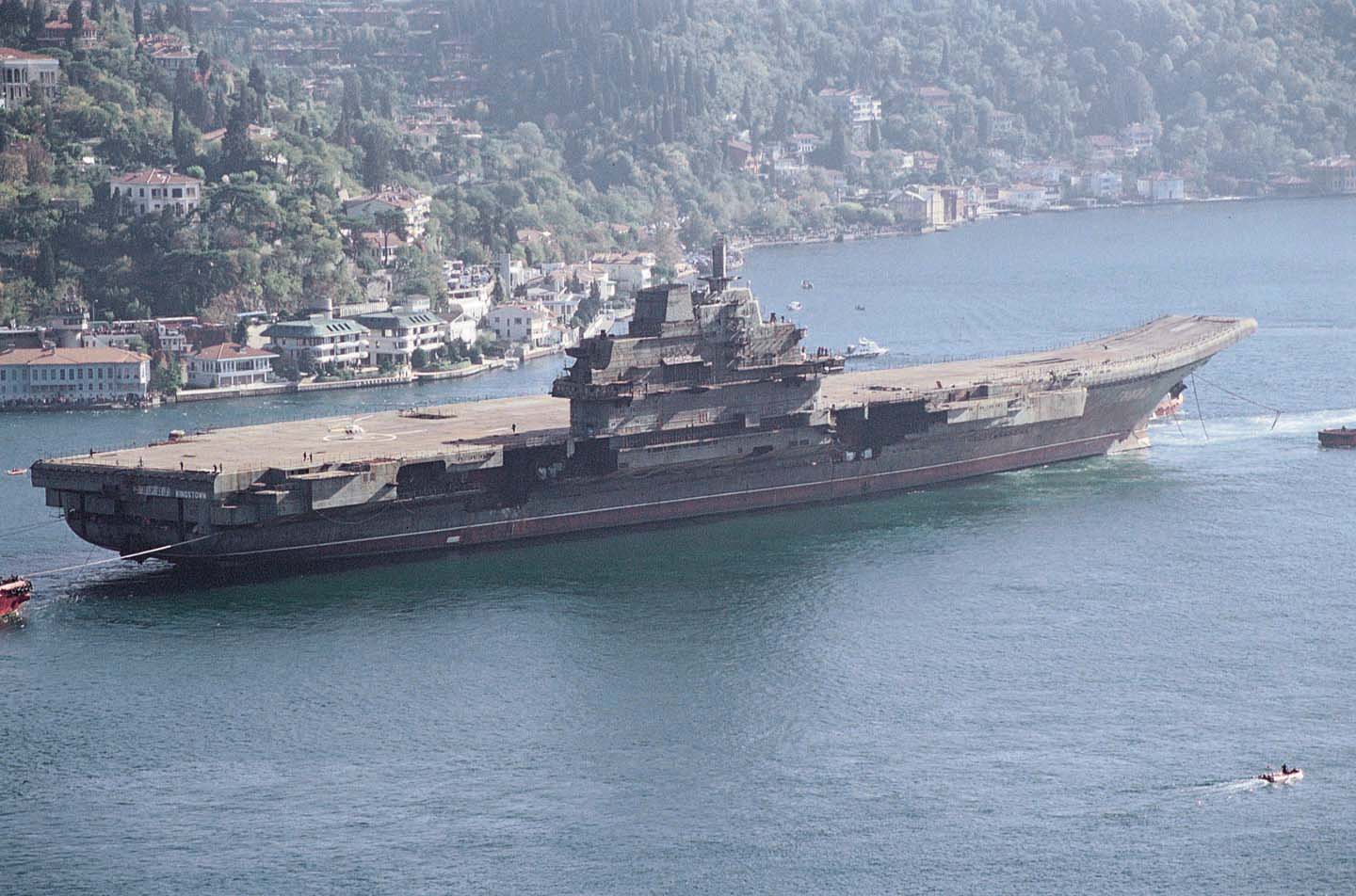
China is still attempting to have a working aircraft carrier. This, the ex-Soviet Varyag, is currently undergoing repairs by the Chinese.

China is the only rising economy that might rival the U.S. eventually in terms of defense spending. I suspect they will have both the potential and the interest in the mid-term future, but we are not there yet.


Unheard of..

So the 'spending more than the rest of the world' factoid is somewhat misleading. It is not that the U.S. is all that militarized by most standards. This is not Wilhelmine Germany, interwar Europe, or even Ronald Reagan's America (about 6% of GDP to the military). It *is* high by today's global standards, mainly because other poles of military power - Western Europe, Japan, Russia - have demilitarized massively. The United States is the last country in the world today seriously interested in projecting substantial military might abroad.


..and normal.

I don't know if 4% of GDP is too high. Certainly, given the size of the U.S., its economy, its scientific successes, this has meant that there has been a rampant and sickening technophilia in the U.S. military. It has been evident since the Cold War, with officers and congressmen seeming to think all their security problems can be resolved by atomic bombs, Huey helicopters, smart bombs, stealth bombers and more 137.5 million-dollar fighter jets… In my opinion, one can trace a straight line in thinking between losing in Vietnam despite dropping more bombs on Southeast Asia than the whole of those exploded in WW2 with the idea that Rumsfeld's "military revolution" would mean Iraq would be a cakewalk.

U.S. military power means our leaders will, every so often, misuse it. Whether this is because of hubris or miscalculation is irrelevant. Assuming no general war, in 20 or 30 years, I am convinced there will be American boys fighting a losing war in some other godforsaken corner of Asia. This is part of what the Founding Fathers' feared. America was meant to be different from Europe, with its vicious circle of power-hungry princes and ravenous wars.


Civil War: an American exception

America has not succumbed to despotism, but it has embraced a very European tradition of permanent semi-war footing, and military adventurism. This was literally un-American before 1941 and has been normal since. (And, to counter the arguments of a Bob Kagan: there were obviously American wars in the 19th Century, even expansionist ones, but there was no peacetime conscription or vast military establishments as in Europe.) So we have this ironic symmetry: the U.S. was exceptional before the Second World War for being the only civilian power, it has been exceptional since the end of the Cold War for being the last military power.

I think we could benefit from an honest and open debate on the issue of American military power. If only so that, every four years, we do not have these ridiculous pissing matches between presidential candidates as who is willing to be ‘stronger-on-defence’ by throwing yet more money at it... without ever detailing which programs in particular make the United States more secure. Although, to be frank, I doubt the country is capable of such a discussion. The fact that so many in our media and political elite portrayed the new defense budget - representing a 4% increase - as a cut seems to confirm this. At least Bob Gates seems committed to reorienting in a more useful manner the necessary curse of organized violence.

Labels: , , ,