Battlestar Galactica
I finally finished Season 4 of Battlestar Galactica today. Spoilers abound.

BSG has for the last four years been some exemplary, bold television. As a series it has its flaws: seemingly bipolar characters, sometimes aimless story arcs, the fact that half the fleet seems to be made up of reporters… And the finale was deeply dissatisfying in many ways – I don’t need to repeat what has been said all over the internet about the gaping plot holes and unbelievably garish, lazy mysticism. At the same time, it had two things that I loved about the series.
The first is the real genius of the show. Its good moments are extremely good, because they are truly compelling. The quality of the actors and naturalistic settings make the characters and situations feel very real. The events gone through are awe-inspiring and we experience them as our own: the confused end of civilization, the claustrophobia of being on the run in tin cans, the wonder at finding a friendly, superior vessel, the despair of finding an Earth of ashes… And that is only scratching the surface. The travails, joy, despair, horror, redemption, and triumphs of the characters are ours. You literally fear, cheer and weep for them. The finale featured a good number of moving scenes and fitting send offs that ran from the shocking through the hopeful to the bittersweet… I loved Season 4 for using a number of characters – Dualla, Gaeta, Athena, Helo – to their full potential and the finale too has priceless moments with Adama, Roslin, Caprica Six, Baltar.

"Bold television"
The second is the show as a format for debate. Themes have included democracy, civil rights, terrorism, war and all that. The main themes in the finale are ones proper to Science Fiction: the nature of artificial life and the dangers of technology. Both themes are extremely timely. Artificial life for the current research on genetically modified food, cloning and stem-cell research. The dangers of technology are always an issue in any human civilization, but especially industrial civilization.

Frankenstein's Monster: Early Cylon
This isn’t particularly new ground. The show’s premise – robots becoming human, usually running amok – is extremely common in Sci Fi. One could cite Blade Runner, Terminator, about half of Isaac Asimov’s cannon, Fritz Lang’s Metropolis… In fact, you can go all the way back to what is perhaps the first Science Fiction novel, Mary Shelley’s Frankenstein. What BSG did was to add to this venerable tradition for the first time on television in a compelling new setting, beautifully executed with stunning CGI and great actors. It has renovated the Promethean Myth, perhaps the most important and commonly addressed question of Sci Fi.

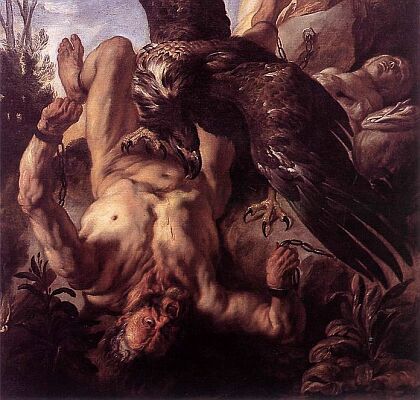
Prometheus: Greek myth...
The conquest of technology, the acquisition of previously forbidden knowledge, these themes go back as least as far as the myth of Prometheus. The Titan Prometheus gives man the ability to use fire. The Gods are angered by this theft. Prometheus is chained to a mountain in the Caucasus, doomed to have his liver devoured by an eagle every day. Man is given a box, unwittingly opened by Pandora, releasing all of the evils into the world. We learn to split atoms, to turn dead dinosaurs into propulsion, to produce everything en masse. In doing so, the world conforms to something approaching our will. Infant mortality drops, lights stay on at night, urban pauperism is reduced to a small minority, EasyJet and Skype destroy the meaning of distance. We do not grow up with rotten teeth to die in our early thirties of dysentery… But we can never predict the effects of Prometheus’s gifts. It was not so long ago that blowing up the Earth was not such a remote possibility. And even today our addiction to various creature comforts might lead to any number of disasters. Whenever we empower ourselves further through technology, turning the world progressively into an extension of ourselves, we must always be aware of the dangers as well as the opportunities.
Debate on the issue seems to split into uncomfortable polarization. On the one hand are those who protest at various summits, or feel empowered by smashing a McDonald’s, variably anti-globalization, anti-genetic modification, anti-nuclear, seemingly entirely emotional and unconstructive (or, in the case of opponents of stem-cell research, driven by reasons of faith). On the other are those, rather low-key these days but very powerful in the Nineties, advocating growth above all, as part of a risk-taking and social Darwinist philosophy, typically displaying an unhealthy technological fetishism. Really, these are two equally nihilist modes of thinking. Only Tom Friedman, cheerleader of the new globalized capitalism cum cheerleader of all things Green, seems to have reconciled the dilemma within himself, although not really satisfactorily.
...flawed metaphor
The Promethean ambition is one of the most important dilemmas facing humanity today. Science Fiction is the only genre really capable of grappling with it. It is no coincidence if the subtitle to Shelley’s classic is The Modern Prometheus. BSG has breathed new life into the debates on artificial life specifically and the Promethean dilemma more generally. These are debates we need. For the myth of Prometheus is in some ways an inadequate metaphor for industrial, scientific Man. It is not the gods who curse us for acquiring new knowledge and technology. We do that ourselves. It is our own political, social, psychological and, indeed, moral character which determines that. We choose whether we split the atom to power lightbulbs or destroy cities, whether we use our surgeons to remove cancers or adjust our noses, whether our factories produce bullets or tennis shoes… We decide.
Not that I would take the producer, Ron D. Moore’s philosophies at face value. The very final scene had an unbelievably heavy-handed Luddite message… (Not that I think a little Luddism is unhealthy.) BSG also provided a fascinating vision of a cyclical pattern to technological development. This pattern could be extended beyond robots that kill their masters (for instance: civilization > nuclear weapons > nuke to Stone Age > repeat). BSG leaves us with much food for thought.
What are we left with after four seasons of BSG? We have an inevitably flawed, beautiful series. We have a striking, compelling story that often soars to very great heights. We have the sublime score of Bear McCreary which I’m sure I will long to for a long time… and something else. It is not often entertainment makes you think. More than that it has made me want to write. But it is bittersweet to see it end, as Tim Kreider writes:
[W]atching it end still made me sort of maudlin and wistful, since we’ve lived with those characters for years now and we’ll never see them again. A TV show creates an artificial family group, it's serial and ritualistic, and it lasts over a sizable fraction of your lifespan, so it’s much better at evoking this feeling of time and finality than even long movies or books--even if that series is as silly and trivial as Cheers. (I still get all nostalgic for a certain era of my life and circle of friends whenever I see an episode of Star Trek: The Next Generation.) It makes you mournful for a whole phase of your life, even if it's only just ending and you didn't even notice it was a phase while you were in it--a sort of nostalgia for the ever-vanishing present. Also I had a big crush on Laura Roslyn.
And to conclude with smiles:
* Galactisimpsons
* Motivational posters.
* BGCast Season 3 Analysis, Parts i, ii
BSG has for the last four years been some exemplary, bold television. As a series it has its flaws: seemingly bipolar characters, sometimes aimless story arcs, the fact that half the fleet seems to be made up of reporters… And the finale was deeply dissatisfying in many ways – I don’t need to repeat what has been said all over the internet about the gaping plot holes and unbelievably garish, lazy mysticism. At the same time, it had two things that I loved about the series.
The first is the real genius of the show. Its good moments are extremely good, because they are truly compelling. The quality of the actors and naturalistic settings make the characters and situations feel very real. The events gone through are awe-inspiring and we experience them as our own: the confused end of civilization, the claustrophobia of being on the run in tin cans, the wonder at finding a friendly, superior vessel, the despair of finding an Earth of ashes… And that is only scratching the surface. The travails, joy, despair, horror, redemption, and triumphs of the characters are ours. You literally fear, cheer and weep for them. The finale featured a good number of moving scenes and fitting send offs that ran from the shocking through the hopeful to the bittersweet… I loved Season 4 for using a number of characters – Dualla, Gaeta, Athena, Helo – to their full potential and the finale too has priceless moments with Adama, Roslin, Caprica Six, Baltar.
"Bold television"
The second is the show as a format for debate. Themes have included democracy, civil rights, terrorism, war and all that. The main themes in the finale are ones proper to Science Fiction: the nature of artificial life and the dangers of technology. Both themes are extremely timely. Artificial life for the current research on genetically modified food, cloning and stem-cell research. The dangers of technology are always an issue in any human civilization, but especially industrial civilization.
Frankenstein's Monster: Early Cylon
This isn’t particularly new ground. The show’s premise – robots becoming human, usually running amok – is extremely common in Sci Fi. One could cite Blade Runner, Terminator, about half of Isaac Asimov’s cannon, Fritz Lang’s Metropolis… In fact, you can go all the way back to what is perhaps the first Science Fiction novel, Mary Shelley’s Frankenstein. What BSG did was to add to this venerable tradition for the first time on television in a compelling new setting, beautifully executed with stunning CGI and great actors. It has renovated the Promethean Myth, perhaps the most important and commonly addressed question of Sci Fi.
Prometheus: Greek myth...
The conquest of technology, the acquisition of previously forbidden knowledge, these themes go back as least as far as the myth of Prometheus. The Titan Prometheus gives man the ability to use fire. The Gods are angered by this theft. Prometheus is chained to a mountain in the Caucasus, doomed to have his liver devoured by an eagle every day. Man is given a box, unwittingly opened by Pandora, releasing all of the evils into the world. We learn to split atoms, to turn dead dinosaurs into propulsion, to produce everything en masse. In doing so, the world conforms to something approaching our will. Infant mortality drops, lights stay on at night, urban pauperism is reduced to a small minority, EasyJet and Skype destroy the meaning of distance. We do not grow up with rotten teeth to die in our early thirties of dysentery… But we can never predict the effects of Prometheus’s gifts. It was not so long ago that blowing up the Earth was not such a remote possibility. And even today our addiction to various creature comforts might lead to any number of disasters. Whenever we empower ourselves further through technology, turning the world progressively into an extension of ourselves, we must always be aware of the dangers as well as the opportunities.
Debate on the issue seems to split into uncomfortable polarization. On the one hand are those who protest at various summits, or feel empowered by smashing a McDonald’s, variably anti-globalization, anti-genetic modification, anti-nuclear, seemingly entirely emotional and unconstructive (or, in the case of opponents of stem-cell research, driven by reasons of faith). On the other are those, rather low-key these days but very powerful in the Nineties, advocating growth above all, as part of a risk-taking and social Darwinist philosophy, typically displaying an unhealthy technological fetishism. Really, these are two equally nihilist modes of thinking. Only Tom Friedman, cheerleader of the new globalized capitalism cum cheerleader of all things Green, seems to have reconciled the dilemma within himself, although not really satisfactorily.
...flawed metaphor
The Promethean ambition is one of the most important dilemmas facing humanity today. Science Fiction is the only genre really capable of grappling with it. It is no coincidence if the subtitle to Shelley’s classic is The Modern Prometheus. BSG has breathed new life into the debates on artificial life specifically and the Promethean dilemma more generally. These are debates we need. For the myth of Prometheus is in some ways an inadequate metaphor for industrial, scientific Man. It is not the gods who curse us for acquiring new knowledge and technology. We do that ourselves. It is our own political, social, psychological and, indeed, moral character which determines that. We choose whether we split the atom to power lightbulbs or destroy cities, whether we use our surgeons to remove cancers or adjust our noses, whether our factories produce bullets or tennis shoes… We decide.
Not that I would take the producer, Ron D. Moore’s philosophies at face value. The very final scene had an unbelievably heavy-handed Luddite message… (Not that I think a little Luddism is unhealthy.) BSG also provided a fascinating vision of a cyclical pattern to technological development. This pattern could be extended beyond robots that kill their masters (for instance: civilization > nuclear weapons > nuke to Stone Age > repeat). BSG leaves us with much food for thought.
What are we left with after four seasons of BSG? We have an inevitably flawed, beautiful series. We have a striking, compelling story that often soars to very great heights. We have the sublime score of Bear McCreary which I’m sure I will long to for a long time… and something else. It is not often entertainment makes you think. More than that it has made me want to write. But it is bittersweet to see it end, as Tim Kreider writes:
[W]atching it end still made me sort of maudlin and wistful, since we’ve lived with those characters for years now and we’ll never see them again. A TV show creates an artificial family group, it's serial and ritualistic, and it lasts over a sizable fraction of your lifespan, so it’s much better at evoking this feeling of time and finality than even long movies or books--even if that series is as silly and trivial as Cheers. (I still get all nostalgic for a certain era of my life and circle of friends whenever I see an episode of Star Trek: The Next Generation.) It makes you mournful for a whole phase of your life, even if it's only just ending and you didn't even notice it was a phase while you were in it--a sort of nostalgia for the ever-vanishing present. Also I had a big crush on Laura Roslyn.
And to conclude with smiles:
* Galactisimpsons
* Motivational posters.
* BGCast Season 3 Analysis, Parts i, ii
Labels: Battlestar Galactica, Science Fiction
posted by CJWilly at 1:18 PM
4 comments