.

The Free State
"Man, in a word, has no nature. What he has is - history."

Monday, August 31, 2009

Escalation in Afghanistan: The Debate
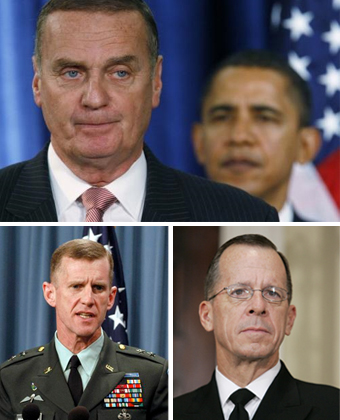

Two escalators (bottom), one WTFer, and one indecider.

9 pieces to understand what is going on:

1) WaPo breaks down the new polls: 1/2 of Americans believe the Afghan War is not worth it, 1/4 are for escalation (above the 21,000 earlier this year), 45% want to decrease troop levels. The administration is going against its (presumably safe) liberal base and has much, much more support from conservatives on this issue.

2) National security expert Anthony Cordesman explains why escalation is necessary in "How to Lose in Afghanistan". He says the US/NATO have been losing over the last 8 years because of insufficient resources. Victory is possible thanks to the vigorous new leadership of General Stanley McChrystal and Ambassador (General) Karl Eikenberry, the concentration of civil-military powers in those two without Washington "micro-managing", and, most of all, more money and soldiers. (McChrystal's predecessor, General David McKiernan, was fired in mysterious circumstances, an action unheard of since MacArthur.) Cordesman notes the debate within the U.S. foreign policy elite, saying that "strong elements in the White House, State Department and other agencies" are opposing the new move. The threat: "an enduring regional mess" and a sanctuary for Al Qaeda." He concludes rather cautiously: "We have a reasonable chance of victory if we properly outfit and empower our new team in Afghanistan".

3) Dexter Filkins at the NYT reports on McChrystal's assessment of the situation: "serious, but winnable." So long as he has the resources to do it. Defense Secretary Robert Gates and NATO Secretary General Anders Rasmussen don't emphasize American soldiers, but Afghan ones: "I would not exclude the possibility that we need more combat troops, but first and foremost I would say that we need to increase significantly the number of Afghan soldiers".

4) There are the dribs and drabs from McChrystal himself... The actions of the past few months - his new "protect the people, don't destroy the enemy" counter-insurgency (COIN) guide, the "new strategy", his appointment as a COIN expert, the emphasis on the Afghan army - appear to me an attempt to rehabilitate the Afghan War the way General Petraeus did the Iraq War. His much-awaited report to the President is secret, allowing Obama to do some very in-character temporizing..

5) The NYT on hundreds of reports of irregularities in the recent election and thousands of complaints, recorded by the Afghan electoral authorities. Hamed Karzai's main opponent, Abdullah Abdullah, alleges fraud and we get an introduction to Afghanistan's "tribal machine" politics.

6) The Guardian intelligently sums it all up, using an illustrative photo of McChrystal to impart a subliminal message (subtle, subtle!).

7) George Will (why not?) in "Time to Get Out of Afghanistan" points out that poppy grows, elections don't change a thing, the economy is minuscule (less than 3$/day per Afghan), counter-insurgency theory says many 100,000s of troops are needed (impossible), the government controls only 1/3 of the country, one shouldn't think we can magically remove what McChrystal called the "culture of poverty" there.. Really quite eloquent when he wants to be. He concludes that if there is reason for the Afghan War then "must there be nation-building invasions of Somalia, Yemen and other sovereignty vacuums?" Instead, he advocates special operations, infiltration and missiles to defend the U.S. from Al Qaeda in Afghanistan, not occupation.

8) Stephen Walt is a little smug that McChrystal and the hawks' assessment of the situation is as negative as he has been blogging for months.

9) William Pfaff opines on the substitution of victory.

Personally, I find it an eerie coincidence that these events are occurring just as I have done so much research on the Indochina War, and specifically, how it was perpetuated and escalated thanks to the promise of a "Vietnamese National Army". All situations are different and I don't claim to be an expert on Afghanistan, but I can't help but be troubled many similarities: a new general, a new strategy, a mobilization campaign, the uniting of civil and military authorities, escalation... all on the promise that our local allies will have their army expand geometrically at the snap of our fingers. The similarity of even the words used sends a chill down my spine.

If we go up the escalatory chain, it is without optimism that I hope the Americans' Afghan National Army will prove a better bet than the French's Vietnamese one.

Labels: , , , , ,

Saturday, August 29, 2009

Obama’s War: Escalation in Afghanistan


We seem to be at a genuine crossroads in Afghanistan. As late as two months ago, National Security Adviser General Jim Jones said, after an additional 21,000 troops were sent earlier this year, that new troop requests would likely lead the president to have “a Whiskey Tango Foxtrot moment.” I don’t know if Obama has shouted “WTF!?” but General Stanley McChrystal, top commander in Afghanistan, is asking for just that.

There is a plan soon to be presented by General McChrystal for perhaps an extra 20,000 men, in addition to the 69,000 already committed are to be sent. Drawdown would theoretically begin in five years. What would be the purpose? In that time, the Afghan army would be tripled from 88,000 men to 250,000 and the Afghan police doubled from 82,000 to 160,000. A recent 7-page “counter-insurgency guide” by McChrystal has said that “The conflict will be won by persuading the civilian population, not by destroying the enemy.” And furthermore: “To protect the population is the mission. The ISAF will have won when the government of the Islamic Republic of Afghanistan has the support of the population.” U.S. efforts, in addition to training policy and military, include the anti-opium drug war, anti-corruption campaigns, and prison reform. In short, what is suggested is a vast, ambitious and long-term project of nation-building.

This new effort is occurring just as criticism of the war has been mounting and a majority of Americans appears to oppose it (nevermind allied opinion in Europe or Canada). The selling campaign by Obama officials has been rather artless. The Chairman of the Joint Chiefs Admiral Mike Mullen said on Meet the Press that “we can develop governance, so then we can develop an economy and they can take over their own destiny.” Mullen then got a little flustered when David Gregory asked him if the American people had “signed up” to nation-building:
No, I'm--right now the American people signed up, I think, for support of getting at those who threaten us. And, and to the degree that, that the Afghan people's security and the ability to ensure that a safe haven doesn't recur in Afghanistan, there's focus on some degree of making sure security's OK, making sure governance moves in the right direction and developing an, an economy which will underpin their future.
Quite. Over at Foreign Policy, we have noted IR professor Stephen Walt questioning “the safe haven myth” in Afghanistan (see response, counter-response). We have Richard Haas, President of the Council of Foreign Relations, arguing in the New York Times that Afghanistan is a “war of choice”. He stops short of actually opposing the Obama escalation but he cites:
The risk of ending our military effort in Afghanistan is that Kabul could be overrun and the government might fall. The risk of the current approach (or even one that involves dispatching another 10,000 or 20,000 American soldiers, as the president appears likely to do) is that it might produce the same result in the end, but at a higher human, military and economic cost.
This “makes Afghanistan not just a war of choice but a tough choice.” He shies away from opposing the escalation outright. He limits himself to asking the administration, Congress and the American people to monitor the situation as closely as possible to see if we are “winning”. If things go badly, we should presumably drawdown our forces. Yet, Richard Holbrooke, Obama’s “South Asia Czar,” recently both denied the U.S. military commitment was “an open-ended event” and was unable to define “victory”. He resorted to a Supreme Court justice’s reputed saying on obscenity: “We’ll know it when we see it.”

In a sense, the effort to “measure” success as Haas advocates is futile. The metrics of counter-insurgency are not exactly scientific. They are open to outright obfuscation by those who, having invested so many men, so much money, and their own political credibility on the war, have trouble saying it is not going well. If we escalate now, we will be there, successful or not, for at least five years.

So there we have it. Counter-insurgency and nation-building in Afghanistan looks like it will be escalated and prolonged under Obama. This indeed will make Afghanistan “Obama’s War” and his credibility and legacy will be inextricably tied to its success. I can understand the political considerations. He campaigned on Afghanistan. In being strong in Afghanistan, he hopes this will immunize him from allegations of Carterite flaccidity if he is conciliatory with regard to Iraq or Iran.


A German soldier and Afghan woman in the bazaar of Taloquan.

But is it wise? If it fails the already high costs of war risk spilling over domestically, doing irreparable damage to Obama’s already shaky domestic agenda. We are asking soldiers to be part-time social workers, indeed social engineers, in a foreign country of which they know nothing. We have enough trouble managing our own societies, which we understand much better. We find prisons, drugs, corruption, fair elections to be sometimes be intractable problems at home. Now the administration are saying that, in five years, the Americans and NATO will fix all that in Afghanistan. They will, in 5 years, train twice as many forces as were created in the past 8. All that, and fight off the Taliban at the same time. It is not that a more limited approach or eventual withdrawal from Afghanistan would be without risks. It is that their narrative for victory is bunk and cannot justify committing ourselves even further to the Afghan adventure.

Labels: , , , , , , ,