
The Abuse of Analogy (I): Postwar Germany and Japan
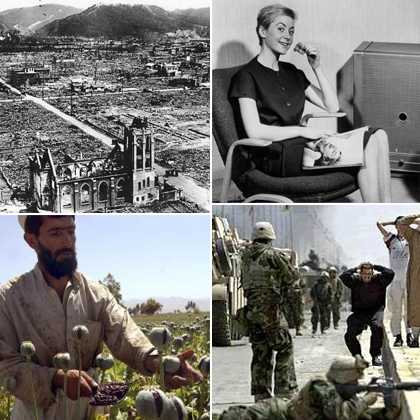
There was a time when many said that the cultures of Japan and Germany were incapable of sustaining democratic values. Well, they were wrong. Some say the same of Iraq today. They are mistaken. The nation of Iraq -- with its proud heritage, abundant resources and skilled and educated people -- is fully capable of moving toward democracy and living in freedom.Those words were spoken by President George W. Bush in a speech to the American Enterprise Institute, February 26, 2003. Now this is a fine way to frame an issue and Donald Rumsfeld tried something similar later on. Instead of dealing with criticisms of how democracy and peace are actually pretty hard to achieve in practice in many parts of the world, it seeks to portray skeptics as believing that the "Arab mind" is congenitally allergic to liberty. Most critics of Bush's policies had no such inclinations, but let us deal seriously with the Japan/Germany analogy as it compares to our wars in Afghanistan and Iraq.
There are too many differences between the Japanese/German postwar miracles (economic growth, democratization, "civilianization") and the current wars in Afghanistan and Iraq for the comparison to be of any use. I will mention the most important.
First, regarding the economy. It is not true that the economic successes of Germany and Japan were principally due to foreign aid. The Third World has received aid to the value of many many times over the Marshall Plan since World War 2, that hasn't stopped many countries under U.S. influence in Latin America (Chile, Columbia), the Middle East (Egypt) or East Asia (Philippines) from being dirt poor. The nation needs to be already be internally "predisposed" towards growth. Let us note that Germany and Japan had been the most modern nations of Europe and Asia respectively. (Which is not to say, that economic growth cannot be ruined by an outside power, as in East Germany.)
In contrast, Afghanistan has basically no formal economy and competes with D.R. Congo and Somalia for title of “world’s poorest nation”. It has got to the point where Allied war costs in Afghanistan (also here) are several times bigger than the entire Afghan economy (about $20 billion). The situation not quite as catastrophic in Iraq, it was a relatively modern country, although 30 years of foreign war, sanctions and civil war have certainly made their mark (and in particular, the flight of the Iraqi middle class from the country in the wake of the chaos caused by the American invasion).
Second, it is notable that Germany and Japan were ethnically homogeneous, unlike Afghanistan or Iraq. There is little to suggest that a persistent U.S. presence in Iraq will be able to undo the sectarian hatreds in that country. The situation in Iraq has been “remedied” in recent years by the fact that the country has largely ethnically cleansed itself into Shiite, Sunni and Kurd areas (the country has over 4.5 million refugees and internally displaced persons). There is no indication that problems of the enfranchisement of the Sunnis, the fair distribution of oil wealth, or the status of the disputed city Kirkuk (indeed the whole of Kurdistan!) are going to be permanently resolved whether Americans are there or not. (For comparison: the West has been in Bosnia and Kosovo for over 10 years now, there are still no real prospects for Serbs, Croats, Bosniaks and Kosovars to live willingly in common states.)
Third, most significant, is that these are completely reversed situations. In Japan and Germany, a conventional war was won against them, and the peace, stability and trade which followed victory allowed positive changes in German and Japanese society. In Afghanistan and Iraq, we are told that positive social change during the war will allow victory. Needless to say, such positive change is difficult to achieve period, even more so in wartime, especially in a guerrilla war involving lack of territorial control, civil war, refugees (often the most educated), and the sabotage of "nation-building" efforts by the insurgents (bombing of Iraqi police stations, infiltration of the national army...).
There may be good arguments for the possibility of "victory" (if we could define the term) in Iraq or Afghanistan, but the analogy of Germany and Japan is not one of them. Carts before horses, poppy farmers before Mitsubishi, double digit economic growth before one can go to market without fear of being car-bombed. This narrative is broke, if I paid taxes I'd want a refund.
For reference: comparison of US aid to Iraq/Germany/Japan.
Labels: Afghanistan War, Analogies, Germany, Iraq War, Japan
posted by CJWilly at 10:54 PM
12 comments