.

The Free State
"Man, in a word, has no nature. What he has is - history."

Tuesday, August 25, 2009

Notes on Counter-Insurgency


I've just more or less finished my dissertation. (Thank effing God!) Advanced countries fighting insurgencies in foreign lands often resort to the solution of training local allies to fight in their place under auspices of a "national army". My subject was the Vietnamese National Army, which was an attempt by the French to do just that in the second half of the Indochina War. After a lot of slogging, any general lessons I might draw from French and other experiences?

First, I am more and more convinced that the notion that indigenous soldiers could somehow replace you is nonsense. If a situation has gotten so bad, that the foreign power needs to send 150,000 or 500,000 men in there, and they are unable to achieve victory at acceptable cost then the insurgents will simply win. There is no chance you are going to be able in the last couple years of the conflict, in your part time, turn the native regime's soldiers (who are variably corrupt, unmotivated, incompetent etc.) into the equivalent of your modern and professional army. It is notable that France, the U.S. and the Soviet Union have all fought insurgencies and left armies they created in their place (Indochina, Vietnam, Afghanistan). In no case was the local regime able to survive more than a few years against the insurgents.

Second, you can supplement your forces with locals. In fact, you have to, they know the terrain, the people, they will be able to nullify what advantages those two things give the insurgents. It will only work if you have a substantial portion of the wartorn nation's public opinion on your side. The only two successful examples (I know of) of counterinsurgency with the largescale use of foreign troops since WW2: British Malaya and the Mau Mau uprising in Kenya. In both cases, the rebels' power was based on an ethnic minority representing only about 1/5 of the country (Chinese in one case, Kikuyu in the other). These were still very difficult wars that required about a decade to win and led to substantial political concessions from the British (granting independence and losing control of both countries).

Third, it is virtually impossible to destroy an insurgency if they have a active anctuary. That is when there is a neighbor where the insurgents can rest, recoup, escape the counterinsurgents, and receive training and materiel. Many places have played such a role: China in the Indochina War (and indeed the Korean War), North Vietnam in the Vietnam War, Pakistan in the Afghan Wars.. This presents an impossible dilemma for the counterinsurgent, who despite his overwhelming military and technological superiority, is unable to locate and destroy the enemy and its sources of power. If it attempts to do so, it would need further escalation and general warefare in another country, which may be beyond available means or acceptable costs. In neither of the successful British cases was there an active sanctuary.

For what this means for today I can't completely say. It is somewhat comforting to know that much of the insurgencies in Iraq and Afghanistan are based on ethnic minorities. At the same time, I find it very distressing for Afghanistan especially, where the Pashtuns are a relatively large minority and AfPak border problem has not been resolved. In the Iraqi case, the change in U.S. strategy and "self-ethnic-cleansing" have led to a somewhat more encouraging situation. I can't predict the future but, ultimately, most of these wars end by the foreign power being reconciled to fact that, really, the area that has cost so many many and required so much of their defense effort is basically marginal to their fundamental interests. Although Iraq may be an exception given its position at heart of a region with so much oil, may be a partial exception to this.

Labels: , ,

Wednesday, August 05, 2009

Street Without Joy

Street Without Joy is the compelling and thoughtful chronicle of the French Indochina War (1945-1954) by the celebrated French soldier turned U.S. scholar Bernard Fall. Fall went on numerous trips to Southeast Asia, often talking with and living alongside French and American soldiers. He was killed by a landmine while with accompanying U.S. forces in Vietnam in 1967.

The meat of the book is committed to various large-scale operations by French forces against the Viet-Minh Communists. Here, Fall's first hand experience shines through, with vivid, all-too-real descriptions of the crushing humidity, of the disgust at peeling off leeches or being struck with dysentery, of feet swollen after endless marches, of the murderous, confusing cacophony of fighting... It is mostly a depressing list of indecisive failures: Ninh-Binh, Hoa-Binh, Operation Lorraine, "Street Without Joy" and other operations, with their familiar pattern of tens of thousands of troops with tanks and heavy weapons getting bogged down in mountain, jungle and marsh, the enemy picking away at them and their supply lines if he was stronger, melting into the bush and the population if he is not.


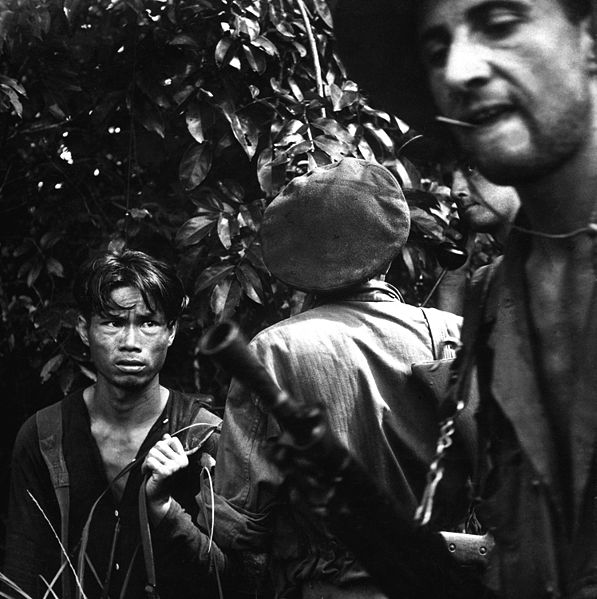
Bernard Fall with U.S. troops in Vietnam.

Viet-Minh attacks were brutal. Frenchmen and their African and Indochinese allies faced artillery fire from an invisible enemy hidden in in the bush, having their faces and limbs blown off, being fried in their tanks, or, if only lightly injured, find their wounds festering for days in the tropical heat. If the V.M. flee, the French had the impossible task of searching villages for Communists and supply depots. The rebel soldiers would hide themselves among the mostly skinny, flat-chested Vietnamese peasant women: a prudish French officer was ordered by his superiors to finger them to find the men among them. At other times, there is no such discrimination. Fall laconically reports his flying beside French bombers as they loose their napalm: 'scratch one Lao village - and we don't even know whether the village was pro-Communist or not.' In a kind of war where the support of the people is critical, the means for tactical victory could spell strategic defeat.

Fall also describes the men and women of Indochina and the French forces in often picturesque detail. Commanders included glamorous and energetic personalities like Free French leader Marshal Jean de Lattre de Tassigny whose son died in Indochina during his command or General René Cogny who had fought in the Resistance and walked with a limp and a cane due to permanent injuries from Gestapo torture. "Ex-Nazi" German Foreign Legionnaires fought alongside French Army survivors of Dachau and Buchenwald... after months spent in the jungle or in a Viet-Minh P.O.W. camp these same soldiers might come home with skeletal bodies 'like Christ off the cross'. The women are numerous. In addition to the usual wives, nurses and female military personnel there is the curious institution (at odds with the book's title) of the ‘Mobile Field Brothels’ of North African prostitutes that accompanied some units. Given that the U.S. was giving substantial aid to the war effort, the brothels gave French P.R. officers some worry at the possibility of an American newspaper headlining that the U.S. was financing French fornication...


A path without joy...

In addition to the individual descriptions of battles and people, Fall wraps his chronicle with a preface and a conclusion that ruminate on the concept of ‘Revolutionary Warfare’, or political insurrection by Communist or Nationalist forces with the aim of subverting an established regime. He describes the experiences Great Britain, France and the United States in Malaya, Indochina and Algeria, to attempt to inform discussion of the escalating war in the Vietnam (the book was published in 1964).

We find here that past experience must inform the present. Fall elaborates concepts that were as valid then in Southeast Asia and North Africa as they are today in Afghanistan and Iraq including the necessity of winning over the population (the primacy of the political over the military) and the notion of a hostile 'active sanctuary' providing refuge, material aid, and sometimes soldiers to the insurgents. Fall's bibliography even lists as the best handbook to counter-insurgency to be a slim, little known volume by French Colonel David Galula, Counter-Insurgency: Theory and Practice. Little known, that is, until about three years ago, when new the top U.S. commander in Iraq David Petraeus began to promote its reading and teachings within the U.S. military and wrote the preface to the most recent edition.


Street Without Joy, for those who love war stories, have an interest in the wars of Southeast Asia, or are students of counter-insurgency.

Labels: , , , ,